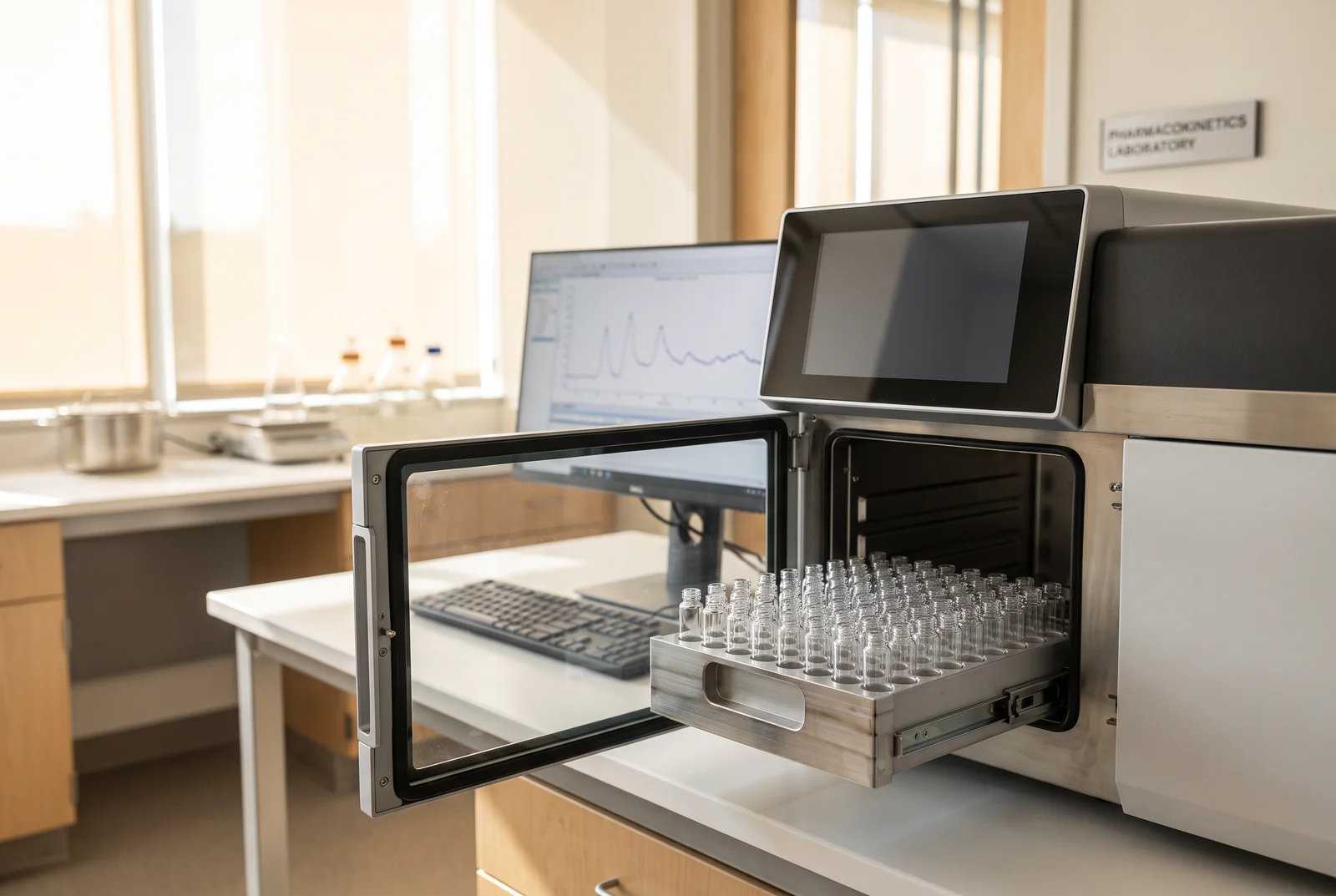
Ascletis says its oral amylin candidate ASC36o has entered a Phase 1 study in the United States, with initial human pharmacokinetic results expected by the end of 2026. The October 20 announcement advances a specific test: whether a swallowed formulation can produce sustained, consistent drug exposure in people. The results presented so far come from animals.[1]
Buy 1, Get 1 20% Off
Pick any two research compounds. Take 20% off the lower priced one.
Applied automatically at checkout, no code needed
Claim my 20% off →In every pair, the lower priced item is 20% off after other discounts; accessories excluded. For research use only.
IQON Labs’ research use only catalog is separate from the investigational medicines and studies discussed here.
A clinical step, with human results still ahead
ASC36o is a peptide designed to activate amylin receptors. Ascletis is developing the tablet for obesity and describes it as the foundation of a broader oral peptide pipeline. Our guide to amylin and its receptors explains the biological target.[1]
The new announcement concerns delivery as much as the molecule. Ascletis’ POTENT formulation platform is intended to improve absorption through the stomach and intestine. Its stock-exchange filing describes prolonged exposure in nonhuman primates and says the US Phase 1 study has started.[2]
Ascletis developed the platform and has a commercial interest in the program. Its announcement provides no human exposure, weight-loss or adverse-event results. It also does not specify the trial’s enrollment, comparator or observation periods. Those details will matter when interpreting the first human readout.[2]
Getting into blood and staying there are separate jobs
Oral bioavailability describes how much of a swallowed drug reaches the systemic circulation. Half-life describes how slowly its measured concentration falls. A formulation can improve the first, while properties of the molecule help with the second. A long half-life cannot, by itself, show that enough peptide crossed the gut wall.[3]
This distinction is easy to lose in a weekly-tablet announcement. The proposed interval depends on exposure after absorption, but absorption must happen reliably enough in the first place. The question is about both the height and the shape of the human concentration curve, rather than the persistence of a molecule in an animal experiment.
Our article on albumin binding and peptide half-life examines one way drug developers extend circulation. Ascletis’ announcement does not establish that mechanism for ASC36o; the immediate question here is whether the oral formulation delivers usable human exposure.
Why an animal tablet result needs a human test
The gut is a moving environment. A peptide and an absorption enhancer must reach the relevant surface together, at concentrations that allow the formulation to work. Gastric emptying, intestinal fluids and transit can change that encounter. These are among the translation problems examined by Sam Maher and colleagues in a 2019 review of oral delivery systems.[3]
That review describes anatomical and physiological differences between humans and laboratory animals, as well as the gap between a controlled intestinal experiment and a swallowed solid formulation. Animal findings can justify testing a candidate without predicting the human result. The review’s authors disclosed consulting relationships with several drug-delivery companies.
Ascletis says POTENT reduces variation both between animals and across repeated measurements within an animal. The filing gives no individual concentration profiles or numerical spread with which to evaluate that claim. A human average alone would also leave an important question unanswered: how consistently does the formulation deliver exposure across participants?[2]
What an early human absorption experiment can establish
A historical oral peptide study shows why those measurements deserve their own stage of development. In 2012, Tuvia and colleagues reported four single-dose studies of oral octreotide in 75 healthy volunteers. They compared its pharmacokinetics with injected octreotide and separately examined effects on growth hormone secretion.[4]
The investigators detected the orally delivered peptide in blood and measured a biological response. Those are two different observations: arrival in the circulation and an effect after arrival. The work included researchers affiliated with the developer, Chiasma. Its healthy-volunteer design was not a long-term patient efficacy trial.
ASC36o is a different molecule with a different target and formulation. The useful precedent is the separation of the questions, not a transferable absorption rate or a prediction of how well Ascletis’ tablet will work.
The next result to watch
The year-end milestone Ascletis has named is human pharmacokinetics: how drug concentrations change over time. For readers assessing that result, the useful evidence will include the population studied, the sampling period and the spread of exposure, alongside the average curve. Any tolerability findings will need their own participant counts and observation window.[1][2]
That readout could show whether the animal delivery findings carry into people well enough to support further testing. Clinical benefit would need to be established in appropriate trials. For now, ASC36o has a stated human test underway and a promised first look at exposure; the company’s proposed weekly oral program awaits those measurements.
Sources and further reading
- Ascletis announcement, October 20, 2026
- Ascletis voluntary stock-exchange announcement, October 20, 2026
- Maher et al. Application of Permeation Enhancers in Oral Delivery of Macromolecules: An Update (2019). DOI: 10.3390/pharmaceutics11010041
- Tuvia et al. Oral octreotide absorption in human subjects (2012). DOI: 10.1210/jc.2012-1179
Related reading
Buy 1, Get 1 20% Off
Pick any two research compounds. Take 20% off the lower priced one.
Applied automatically at checkout, no code needed
Claim my 20% off →In every pair, the lower priced item is 20% off after other discounts; accessories excluded. For research use only.