A 39-person randomized pilot found less average weight regain with delivered meals or a behavioral app during four months after GLP-1 treatment ended, although average weight rose in all three groups. Published October 7 in Obesity Science & Practice, the study offers an early test of practical support during that transition. Its main outcomes were adherence and satisfaction, making the weight finding a reason for a larger trial rather than an established maintenance strategy.[1][2]
Buy 1, Get 1 20% Off
Pick any two research compounds. Take 20% off the lower priced one.
Applied automatically at checkout, no code needed
Claim my 20% off →In every pair, the lower priced item is 20% off after other discounts; accessories excluded. For research use only.
This report covers clinical research, not instructions to stop or change medication. The IQON Labs catalog placement is separate from the trial.
What participants received after treatment stopped
GLP-1 stands for glucagon-like peptide-1. Medicines called GLP-1 receptor agonists act on the receptor for that hormone and are used in diabetes and obesity treatment. The pilot recruited adults who had already lost more than 10% of their body weight during treatment and had stopped within the previous 30 days. It tested support after cessation, without a group assigned to continue medication.[1][2]
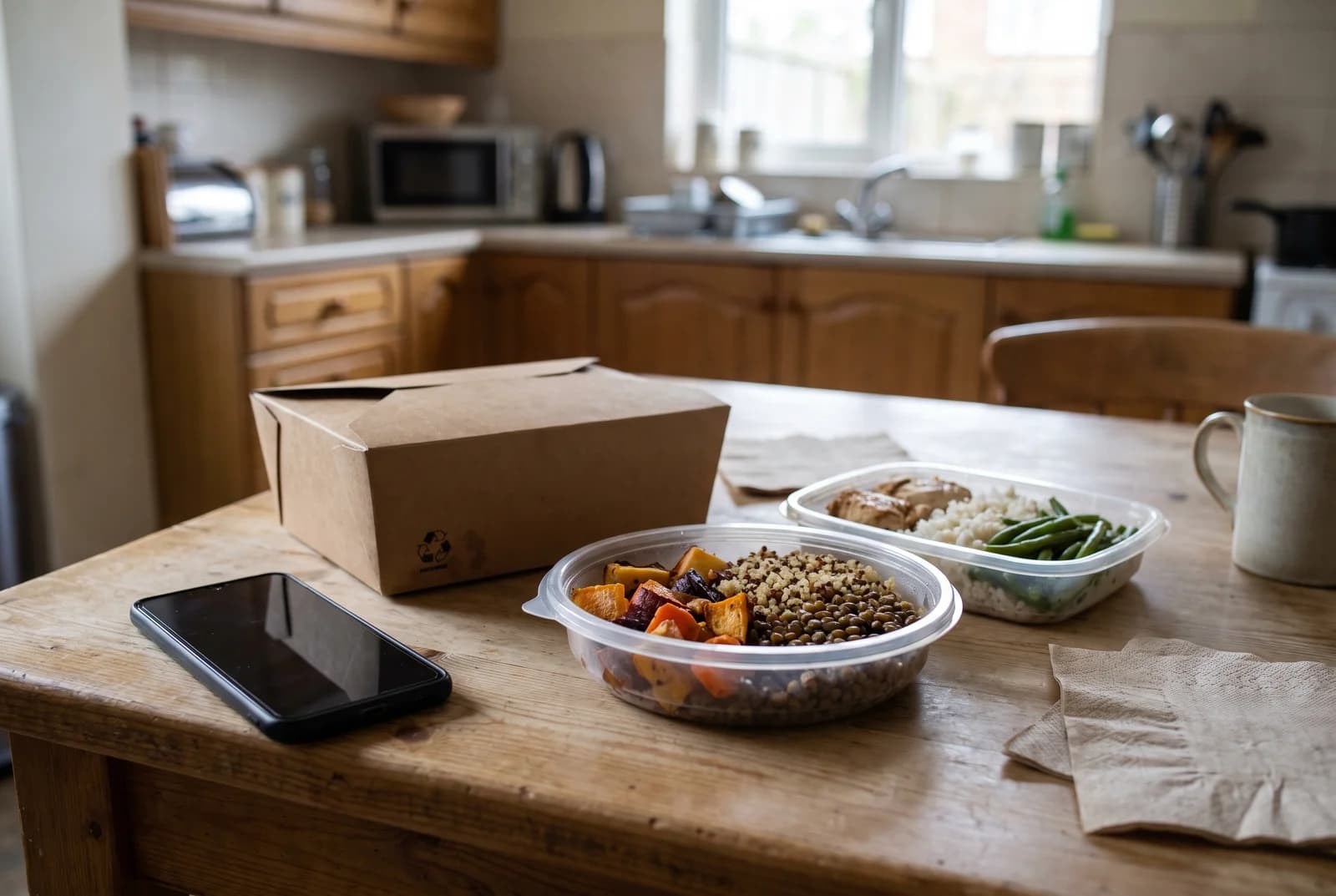
Investigators assigned 14 participants to usual care, 12 to a Noom subscription and 13 to medically tailored meals. Noom provided behavioral lessons and tools for recording eating, exercise and weight. The meals, supplied through RFoodX, were prepared foods developed by dietitians. Participants selected ten meals per week for home delivery during the four-month intervention.[1]
The two approaches addressed different burdens: the app asked people to practice self-monitoring and behavioral skills, while the food deliveries reduced the work of planning and preparing meals. Study funding paid for both services. Usual care remained at each referring clinician’s discretion, with no standardized program supplied by the researchers.[1]
The trial ran remotely from March 2024 through August 2025, using connected scales to collect weights. Funding ended before the planned enrollment of 60 was reached, leaving 39 randomized participants. That recruitment shortfall is why the registry labels NCT06273163 terminated. The October 2026 publication reports the completed pilot’s findings.[1][2]
How much weight returned over four months?
The statistical model estimated a four-month gain of 10.75% of study-entry body weight with usual care, compared with 3.60% with Noom and 3.58% with meals. These are modeled group estimates, not a claim that every participant regained weight. Their 95% confidence intervals were 7.03% to 14.47%, 0.08% to 7.11% and 0.19% to 6.96%, respectively.[1]
Compared with usual care, the app group’s estimated gain was 7.16 percentage points lower, with a 95% confidence interval from 2.04 to 12.27 points lower. The meals group’s difference was 7.17 points lower, with an interval from 2.14 to 12.20 points lower. Those wide ranges convey how uncertain the size of the difference remains in a small pilot.[1]
The denominator matters: these percentages use weight at study entry, after the earlier medication-associated loss. They do not say that participants regained 10.75% or 3.60% of the weight they had previously lost. That is a different calculation.[1][2]
Thirty-four participants completed a final weigh-in. The trial’s flow diagram lists analysis groups of ten for usual care, eleven for Noom and thirteen for meals. Four usual-care participants were lost to follow-up, and one participant discontinued the app. The weight model used available repeated measurements from people with a baseline weight and at least one later measurement, rather than requiring every monthly reading.[1]
The near-identical app and meal estimates do not establish that the programs work equally well. The pilot was too small for a definitive comparison between them or for a precise prediction of an individual person’s weight change.[1]
The primary outcomes tell a different part of the story
Adherence and satisfaction were the registered primary outcomes at four months. Neither differed significantly between the support groups and usual care. On average, meal recipients reported eating about eight of the ten supplied meals per week, while app recipients reported using Noom on about 2.8 days per week. These were participant reports, not independent app-use logs or direct observation of meals eaten.[1][2]
The registry listed the percentage of earlier weight loss maintained as a secondary outcome. The paper instead reports change from the first post-consent weight and describes weight as exploratory. Its favorable weight result therefore should not be presented as success on the trial’s primary objective, or as the registered percentage of prior loss maintained.[1][2]
This distinction also helps explain the next research question. The scales suggest that the support packages affected the early weight trajectory, but the questionnaires did not clearly identify why. A larger study could examine how engagement or food access relates to weight change, with enough participants to distinguish those possible explanations.[1]
Why the starting groups and safety reporting matter
Randomization did not produce closely balanced groups in this small sample. At entry, mean prior weight loss was 21.2% with usual care, 17.7% with Noom and 15.6% with meals. Mean starting weights were 76.5, 91.4 and 87.9 kilograms, respectively. All fourteen usual-care participants were women, compared with seven of twelve app participants and eleven of thirteen meal participants.[1]
After adjustment for earlier weight loss and baseline weight in participants with the necessary data, the estimated differences narrowed to 5.83 percentage points for Noom and 6.29 for meals versus usual care. Both remained statistically significant in that sensitivity analysis. The analysis supports the direction of the finding, while showing that its magnitude depends partly on how baseline differences are handled.[1]
Participants also had different previous treatments, including semaglutide, tirzepatide and a cagrilintide plus semaglutide combination. This was not a uniform withdrawal study of one medicine. Our amylin explainer describes why an amylin-based combination and a GLP-1 medicine involve different hormonal targets.[1]
Safety reporting was limited. Two participants reported side effects on the satisfaction questionnaire administered at the end of the four-month intervention. The paper does not give a detailed event breakdown or a clearly defined safety-analysis population for that finding. It cannot establish that either support program is safer than usual care.[1]
The services were free to participants, most of whom were women and college graduates. Four months of supported access cannot show whether people would sustain the same engagement when paying themselves, or whether the weight difference would persist over a year.[1]
How this fits the earlier STEP 1 withdrawal study
The earlier STEP 1 extension documented weight regain after semaglutide and structured lifestyle support ended at week 68. Its off-treatment analysis included 327 participants from the larger trial. At the final site visit at week 120, data were available for 197 former semaglutide recipients and 93 former placebo recipients; the original trial’s full enrollment is not the denominator for that one-year observation.[3]
The former semaglutide group regained an average of about two-thirds of its earlier loss over the following year. That study, funded by Novo Nordisk, supplied context for the difficulty of maintaining weight after withdrawal. It did not test the app or meals in this pilot, and the populations, support arrangements and follow-up periods differ. Comparing their headline percentages would not be a head-to-head comparison.[3]
The newer pilot takes the question a step further by assigning specific support after people have stopped treatment. It suggests that the early trajectory may be changeable, while leaving durability and health outcomes beyond weight unresolved.[1]
Who funded the pilot, and what comes next?
The pilot received support through the UT Southwestern Nutrition Obesity Research Center’s NIH/NIDDK grant and a UT Southwestern community research award. Lead author Kelseanna Hollis-Hansen later received Noom funding for a larger, longer follow-up study, after this pilot had been completed and submitted for publication. The authors state that Noom had no influence on the pilot’s design, conduct, reporting or interpretation.[1]
Coauthor Ildiko Lingvay disclosed research funding or products and other professional relationships with multiple companies, including Novo Nordisk and Eli Lilly. These disclosures belong alongside results involving commercial services and a population previously treated with weight-management medicines.[1]
At publication, the Noom-funded follow-up was preparing for recruitment. A longer trial can test whether the early difference persists after four months and whether it accompanies improvements in health measures beyond weight. That is the practical promise of this pilot: it identifies a support strategy worth testing over the period when maintaining weight becomes the harder question.[1]
Frequently asked questions
Did the trial test using the app and meal deliveries together?
No. Participants were assigned to usual care, the app or meals. There was no combined app-and-meals arm, so the pilot cannot estimate whether combining the services would add a benefit.
Did the pilot establish that these services save money?
No. The registry planned a cost-effectiveness outcome, but the published report does not provide a completed cost-effectiveness comparison. Study funds covered the app subscription and meal deliveries. Affordability outside the study remains a separate question.
Sources and further reading
- Hollis-Hansen et al.: Preventing weight regain after GLP-1 therapy discontinuation, pilot randomized trial. DOI: 10.1002/osp4.70194
- ClinicalTrials.gov: NCT06273163 trial design, endpoints and termination reason
- Wilding et al.: Weight regain and cardiometabolic effects after semaglutide withdrawal, STEP 1 extension. DOI: 10.1111/dom.14725
Related reading
Buy 1, Get 1 20% Off
Pick any two research compounds. Take 20% off the lower priced one.
Applied automatically at checkout, no code needed
Claim my 20% off →In every pair, the lower priced item is 20% off after other discounts; accessories excluded. For research use only.