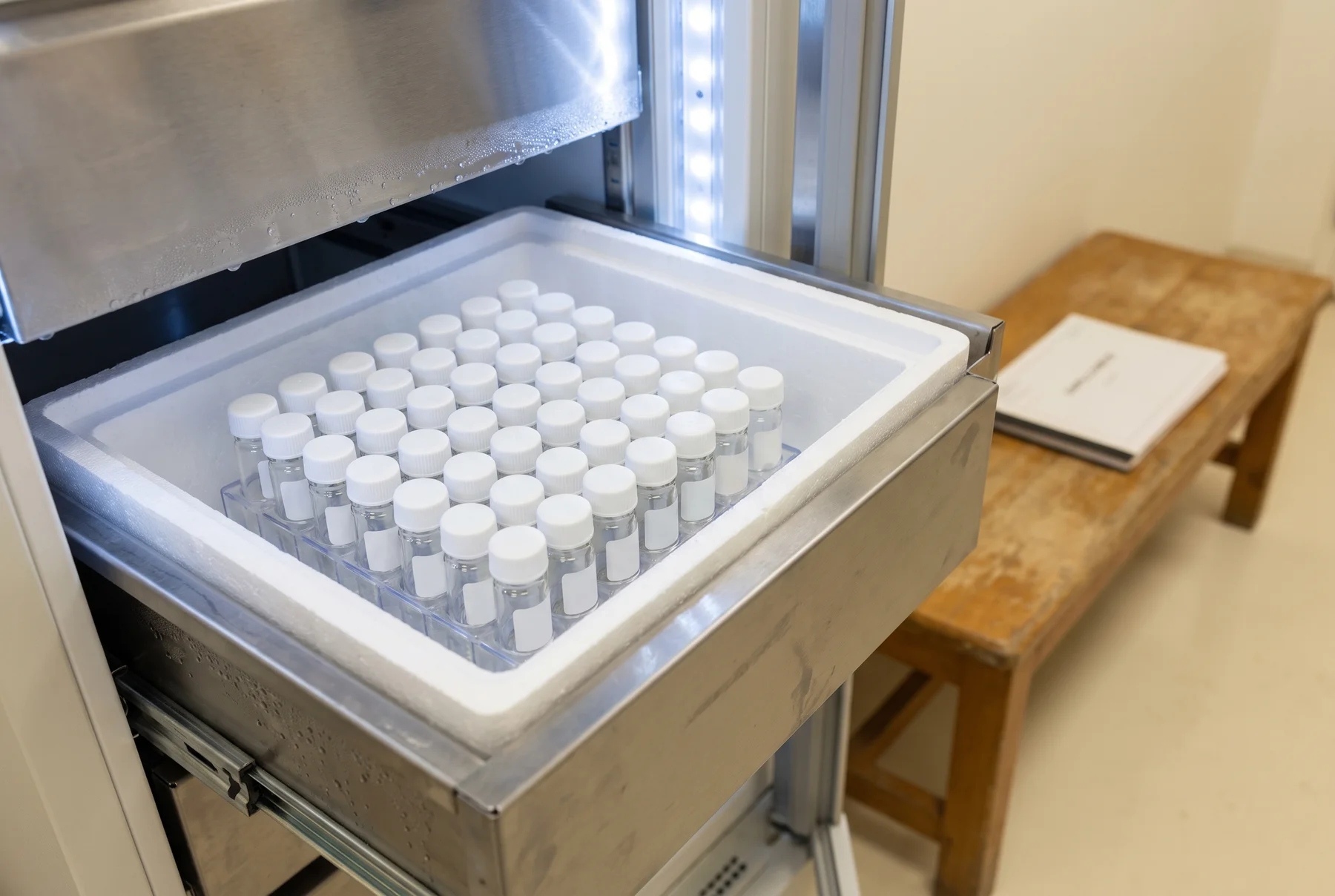
Repeated freezing and thawing can change a research peptide sample, but no universal cycle count predicts damage. Three bench studies found different outcomes: more loss in repeatedly thawed mixtures, about full recovery of one formulation after five cycles, and worse measurement variability after ten cycles despite similar average signals. The sequence, solution and measurement determine what those results mean.[1][2][3]
Buy 1, Get 1 Free
Pick any research compound. The second one is on us.
Applied automatically at checkout, no code needed
Claim my free vial →Lower priced item free; accessories excluded. For research use only.
This article concerns laboratory evidence, not suitability for use in people. The IQON catalog placement is separate from the studies.
Key facts
- A dry, freeze dried peptide and a peptide dissolved in liquid are different storage problems. Supplier guidance generally favors sealed, dry storage for longer periods, while stability in solution depends on the specific sequence and conditions.[4][5][6]
- One original experiment followed peptides from two protein digest samples over ten months. Single use frozen aliquots showed less loss than a repeatedly thawed stock in that experiment.[3]
- A different original study found approximately full recovery of one buffered peptide after five freeze thaw cycles. It did not test every peptide or every assay endpoint.[2]
- A targeted mass spectrometry study found that average peptide signals could remain comparable even when the repeatability of measurements worsened after ten cycles.[1]
What counts as freeze thaw damage?
A peptide is a chain of amino acids. In laboratory work it may arrive freeze dried or in solution.[5][6] Taking a sealed dry vial out of a freezer is not the same event as repeatedly melting and refreezing an aqueous stock.[4][6] Lyophilized means dried by freezing and removing water. The storage guidance identifies moisture exposure as a threat to the stability of that dry material.[4]
"Damage" also needs a defined measurement. A chemical method might detect a modified peptide.[5] Chromatography might show less recoverable parent material.[2] A mass spectrometry assay might see a similar average signal but greater variation from run to run.[1] Those are different outcomes. In the targeted assay study below, average peak areas were comparable, yet variation was greatest after ten cycles.[1]
The useful question is not "How many thaws are allowed?" It is "Which property of this peptide, in this solvent, must remain within the experiment's criteria?"[1][2] Manufacturer guidance recommends limiting repeat cycles, but that is not a measured universal loss per cycle.[4][6]
What did the three bench studies actually compare?
A ten month peptide mixture experiment. Researchers digested bovine serum albumin and a mixture of six bovine proteins into smaller peptides.[3] These were proteomics samples, used to study proteins through measurements of their peptide fragments, not a clinical product.[3] An aliquot is a separate portion of a larger sample. The samples were stored in 5% formic acid in glass vials.[3] One set consisted of separate aliquots thawed once; another came from a stock thawed, sampled and refrozen each month.[3]
They measured signals by liquid chromatography and mass spectrometry, which separates components and detects ions by mass, in technical triplicate every four weeks over ten months. The two starting samples were protein digests; the three measurements at each time point were technical repetitions, not three separately sourced biological samples.[3] The analysis tracked fifty prominent peptide peaks from the albumin digest and ten peaks for each of the six proteins in the mixture.[3]
Separate aliquots showed less peptide loss than repeatedly cycled stock.[3] The pattern differed between digests and individual peptides.[3] The authors reported a dilution error behind one outlier.[3] The study supports careful aliquoting for comparable proteomic analyses, not an expiry date for a different sequence.[3] Its measured comparison was between instrument signals, not absolute amounts of chemically intact material. We report the direction of that comparison, not a percentage of chemical damage or a numerical loss per thaw. Ion area alone cannot supply either estimate.[3]
A formulated, seven residue peptide. Another team examined one short peptide in Dulbecco’s phosphate buffered saline, abbreviated DPBS, and Tris buffered saline, or TBS.[2] The experiment compared five cycles at minus 20°C and minus 80°C. Each experimental cycle included one hour frozen and one hour thawing at 25°C.[2] These were the researchers’ test conditions, not a storage or preparation procedure for other materials. Samples were analyzed by high performance liquid chromatography, or HPLC, which separates components so that a detector can measure the peptide recovered.[2] The study reported about 100% recovery in both buffers after five cycles, with no detected aggregate or precipitate on its reported measures.[2]
That is a counterexample to claims that a second or third cycle must destroy a fixed percentage.[2] But it is one sequence with specific buffers, concentrations, temperatures and readouts.[2] The cycle subsection does not clearly state an independent sample count for that comparison. Five cycles is the number of handling events, not five independent samples, and the reported recovery does not establish every functional property.[2] Formulation and storage conditions mattered elsewhere in the study.[2]
Peptide standards used for mass spectrometry. A consortium paper included a small handling experiment.[1] Investigators prepared twelve aliquots of a peptide mixture in water containing 3% acetonitrile and 0.1% formic acid, in polypropylene tubes stored at minus 80°C.[1] One remained at 4°C after thawing, one underwent ten cycles, and ten were thawed once.[1] Each sample was measured in triplicate over ten consecutive days. These were repeated instrument measurements of the same material, not independent biological samples or people.[1] Peak area is the size of the instrument signal assigned to a peptide; reproducibility describes how consistently repeated measurements agree.
Average peak areas were broadly comparable.[1] Yet variability was highest after ten cycles.[1] For most peptides, variability was approximately 1.5 to 3.5 fold lower in the freezer storage arm with a single thaw than in the other conditions, meaning chilled storage or ten cycles.[1] The measure was the coefficient of variation, the spread of readings relative to their average, not the amount of chemical loss. That comparison does not mean 1.5 to 3.5 times more intact peptide survived.[1] These were technical measurements of a defined mixture, not a survey of all peptide formulations.[1] An average describes the center of the readings. Variability describes their spread. A similar average can therefore hide a less dependable individual measurement. That distinction matters when an experiment depends on detecting small differences.[1]
Taken together, the reports are not a vote on whether peptides are "fragile" or "indestructible." They studied different sequences, solvents, periods and endpoints.[1][2][3] One formulation tolerated several cycles,[2] another mixture lost more material with repeated cycling,[3] and a third showed worse precision despite similar means.[1]
Why do the dry vial, refrigerator and frozen solution get different advice?
Lyophilization removes much water, but dry material can still be affected by moisture or oxygen.[4][5] Sigma Aldrich says sequence determines stability and dry material is generally more stable than a solution.[5] Its guide stresses keeping dry vials closed and away from moisture and strong light.[4] Thermo Fisher also treats dry material and prepared solutions differently.[6]
Once dissolved, solvent, acidity, air and sequence become relevant.[5] The chemistry guide describes oxidation, chemical changes involving susceptible parts of a molecule; deamidation, a change in certain amino acid side groups; and hydrolysis, bond cleavage involving water.[5] These are possibilities, not a prediction of every vial's rate. A refrigerator temperature alone cannot settle an untested storage period or endpoint.[2][3]
Freezing a solution may slow changes, while repeatedly cycling the same stock adds a handling variable.[3][4] Sigma Aldrich and Thermo Fisher recommend avoiding repeat cycles or using separate working portions.[4][6] Neither instruction guarantees that one cycle is harmless or a later cycle fatal.[2][3] Material specific documentation and a validated assay take precedence over a generic shelf life chart.[1][4]
How can a lab tell whether its stored peptide still fits its experiment?
Begin by defining the property the study needs to preserve. A mass spectrometry standard may need consistent signal and precise concentration.[1] Another assay may need a different endpoint. The consortium report found sequence dependent peak area variability and the least repeatability in the ten cycle condition.[1]
Compare stored material with a baseline using a method suited to the question. The longitudinal study measured signals over time and compared separate aliquots with cycled stock.[3] Record solvent, container, interval and handling history for an interpretable comparison.[1][3] An original lot certificate is not a time course study after freezer storage. Our COA guide addresses initial identity and purity, not post storage stability.
Visible appearance is not a complete answer. The appearance of a dried cake cannot alone identify chemical breakdown products or quantify recovery.[2] The formulated peptide study reported chromatographic recovery and whether aggregates or precipitate were detected.[2]
What remains uncertain?
These are bench measurements, not human trials. They contain no clinical population, treatment comparator or evidence that stored research material is suitable for people. The repeated measurements improve the description of those samples but do not expand the range of peptide sequences actually tested.[1][2][3]
The formulation paper reports funding through a sponsored research agreement with Lung Therapeutics, which also supplied the peptide. The paper discloses that coauthor John J. Koleng acted on behalf of that company. That commercial interest matters when reading its narrow formulation result. The longitudinal study acknowledges support from the Austrian Academy of Sciences and the Austrian Science Fund.[2][3]
Single use frozen aliquots avoid repeat cycling, as two manufacturers recommend.[4][6] But the measured outcome depends on the material and question: loss, chemical change and variability differ.[1][2][3] The defensible answer is a sequence specific stability assessment, not a universal cycle limit.[1][2][3]
Frequently asked questions
Does a single freezing and thawing cycle always ruin a peptide?
No. The short peptide formulation retained approximately full measured recovery after five cycles. Other experiments found loss or reduced precision after repeated handling. None establishes a universal safe cycle count or loss per cycle for a different material.
Should a laboratory working solution be refrigerated or frozen?
That depends on the material and the endpoint. Manufacturer instructions distinguish dry material from solutions and caution against repeated cycles. In the standards experiment, chilled storage and frozen storage produced different measurement variability. A temperature alone cannot establish a universal lifetime.
Will a frozen peptide aliquot stay stable for months in a mixed solvent?
The evidence must match that sequence and solvent. The ten month study used protein digests in an acidic solution; the five cycle study used one short peptide in particular buffers. Neither validates months of storage for an unrelated laboratory mixture.
Does a different looking dried cake prove that the peptide degraded?
No. Appearance is not a measurement of how much intact peptide remains. The formulation study assessed recovery and physical changes separately. A visible difference can prompt investigation, but an analytical comparison is needed to establish a change relevant to the experiment.
Does a room temperature excursion automatically ruin a research peptide?
Not automatically, but these studies cannot clear an unknown sample for further use. One formulation study included a 48 hour solution storage comparison; that does not answer for another sequence, a longer interval or different conditions. Relevant stability evidence is needed.
Sources and further reading
- CPTAC recommendations for using peptide standards in targeted proteomics. DOI: 10.1373/clinchem.2015.250563
- Formulation composition and process effects on a short peptide. DOI: 10.3390/pharmaceutics11100498
- A longitudinal proteomic assessment of peptide degradation and loss under acidic storage conditions. DOI: 10.1016/j.ab.2014.11.020
- Sigma Aldrich: handling and storage of peptides
- Sigma Aldrich: peptide stability and degradation
- Thermo Fisher: handling and storage instructions for standard peptides
Related reading
Buy 1, Get 1 Free
Pick any research compound. The second one is on us.
Applied automatically at checkout, no code needed
Claim my free vial →Lower priced item free; accessories excluded. For research use only.