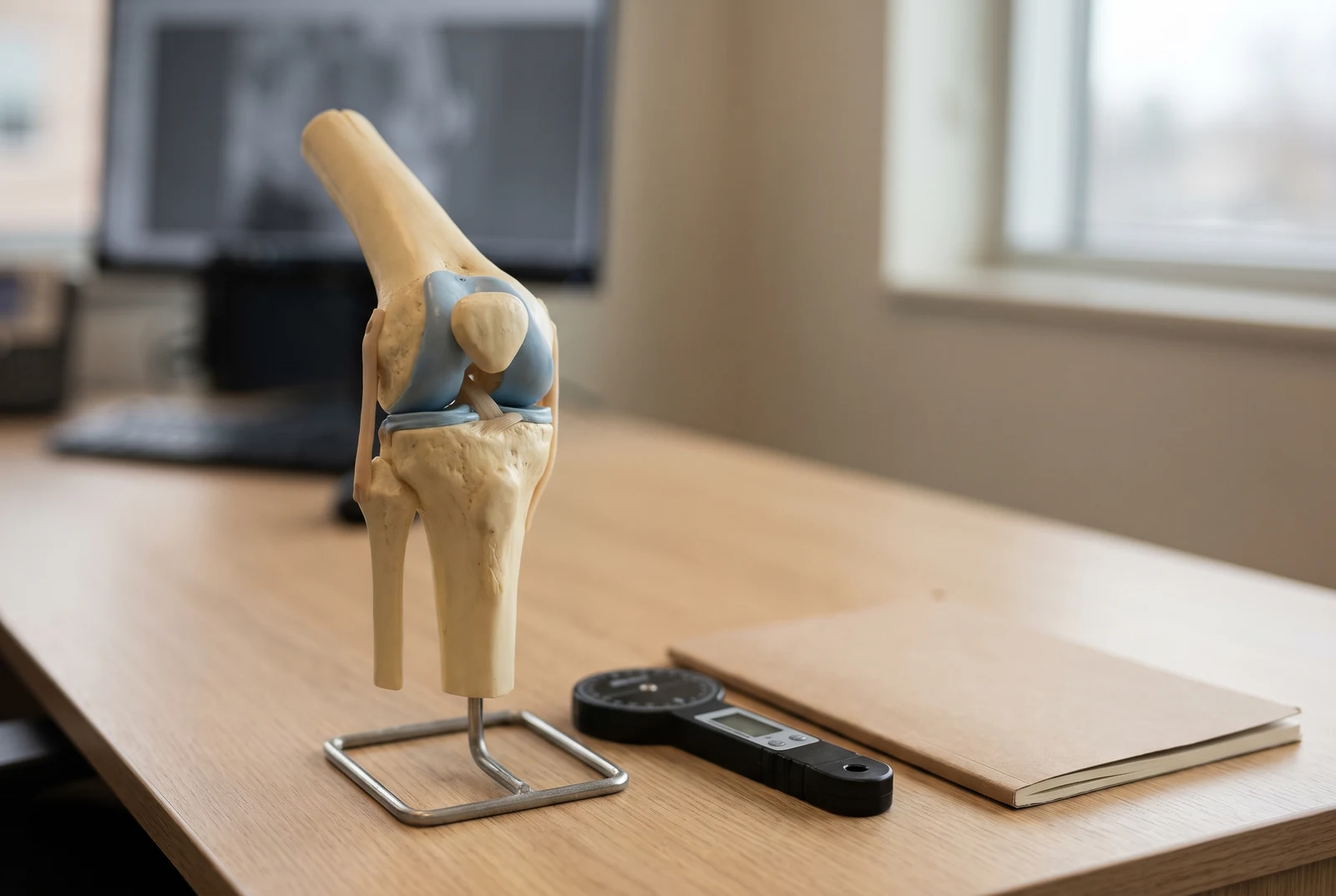
Retatrutide reduced knee osteoarthritis pain by about 4.4 points on a scale from 0 to 10 in a Phase 3 trial, compared with a 2.4 point improvement on placebo. The 68 week results in adults with overweight or obesity put a substantial improvement in daily symptoms alongside weight reduction. Lilly highlighted the findings on November 5 ahead of a presentation scheduled for November 8 at ACR Convergence 2026.[1][3]
Buy 1, Get 1 20% Off
Pick any two research compounds. Take 20% off the lower priced one.
Applied automatically at checkout, no code needed
Claim my 20% off →In every pair, the lower priced item is 20% off after other discounts; accessories excluded. For research use only.
Update, November 8, 2026: We revised the conference timing language after the scheduled session date. No new trial results were added.
Retatrutide remains investigational. This article covers clinical research, not treatment instructions. IQON Labs' research use only catalog is separate from the clinical trial.
A trial built around painful knees
Lilly first announced the trial's topline results on December 11, 2025. This week's news is the conference announcement ahead of the November 8 presentation, with the ACR abstract providing a closer look at the trial analysis.[8][3][1]
TRIUMPH 4 enrolled 445 adults with knee osteoarthritis and a body mass index of at least 27. Their pain scores at entry had to fall between 4 and 9 on the WOMAC pain scale, which measures osteoarthritis symptoms. The average starting pain score was 5.95. Participants had persistent knee pain and moderate changes on knee X rays; the registration excluded people with diabetes.[1][2]
Random assignment divided participants among two retatrutide arms and placebo. The trial doses, 9 mg and 12 mg, identify the research groups: 148 people entered each active arm and 149 entered the placebo arm. Participants and investigators were masked to allocation. Change in knee pain and percentage change in body weight at week 68 were the two primary outcomes.[1][2]
Retatrutide activates receptors for three hormones: glucose dependent insulinotropic polypeptide, glucagon like peptide 1 and glucagon. The study asked whether this investigational treatment could improve pain and weight together in this particular population. Its knee outcome is separate from the broader obesity results covered in our TRIUMPH 1 report.[1][3]
The additional benefit beyond placebo
At week 68, the estimated mean WOMAC pain score fell by 4.48 points in the 9 mg arm and 4.41 points in the 12 mg arm. The placebo group improved by 2.43 points. Subtracting that placebo improvement gives an additional reduction of 2.05 and 1.98 points, respectively, on the same 0 to 10 scale. Both active groups differed from placebo with p values below 0.001.[1]
That comparison matters because the placebo group also felt considerably better. The whole 4.4 point reduction cannot be attributed to the active drug. The result supporting retatrutide is the extra improvement seen against the randomized comparison group, under the conditions of this trial.[1]
The abstract labels these results as an efficacy estimand, a defined way of estimating the treatment effect. Its figure distinguishes measurements observed during treatment from the model based estimates at week 68. Fewer participants contributed observed measurements at that visit than originally entered the trial, so the headline values should be read as statistical estimates rather than a simple average of 445 final questionnaires.[1]
Movement and weight changed too
Pain was accompanied by improvement in physical function. On the WOMAC function scale, also scored from 0 to 10, estimated mean improvements at week 68 were 4.14 and 4.20 points in the two active groups, versus 2.06 with placebo. This was a secondary outcome, giving the pain result a second, practical dimension: how much difficulty participants reported with physical activities.[1]
Mean body weight fell by 26.4% in the 9 mg group and 28.7% in the 12 mg group, compared with 2.1% on placebo in the efficacy analysis. Participants began at an average weight of 112.7 kg and an average body mass index of 40.4. Those starting characteristics matter when considering who the results describe.[1]
Weight and symptoms improved together, but the study had no comparison group designed to isolate pain relief at the same amount of weight loss. It therefore leaves open how much of the pain benefit came through weight reduction and how much through other pathways. The reported outcomes concern symptoms and function, rather than evidence of cartilage regeneration.[1][2]
Why the percentage headline needs context
Lilly's announcement describes pain reduction of up to 75.8%. Its footnote says percentage change in the WOMAC pain score was not prespecified and came from a post hoc analysis, meaning it was calculated after the original analysis plan. The prespecified primary pain outcome was change in scale points. Keeping those measures separate preserves the promising result without giving the later percentage calculation the same status as the primary endpoint.[1][2][3]
The percentage also describes change from the starting score, not the proportion of participants whose pain disappeared. An average reduction, a difference from placebo and the share reaching a symptom threshold answer different questions. Here, the randomized comparison shows approximately two additional points of improvement against placebo.[1][3]
Tolerability remains part of the result
The most common adverse events were gastrointestinal, generally mild to moderate and mostly occurring during dose escalation. The safety table also records serious adverse events and deaths in the active treatment groups, and more treatment discontinuations associated with adverse events than in the placebo group. The table alone does not assign the deaths to treatment.[1]
The safety analysis included 444 participants who received at least one dose, rather than all 445 randomized participants. Its abstract does not specify the complete safety observation window separately from the 68 week efficacy endpoint. That limits a precise comparison of safety rates here; a full report will need to set out both timing and event assessment. Lilly sponsored the trial, and several abstract authors are company employees.[1][2]
The conference abstract
The American College of Rheumatology scheduled abstract 0871 for November 8. The available conference abstract reports the randomized comparison and its statistical analysis.[1]
For knee osteoarthritis research, the useful advance is concrete: a treatment aimed at metabolic disease improved pain and physical function substantially more than placebo in people who also had overweight or obesity. The next question is how those symptom gains hold up over time and fit with the full tolerability record. TRIUMPH 4 gives that discussion a measured clinical result to build on.[1][2]
Sources and further reading
Related reading
Buy 1, Get 1 20% Off
Pick any two research compounds. Take 20% off the lower priced one.
Applied automatically at checkout, no code needed
Claim my 20% off →In every pair, the lower priced item is 20% off after other discounts; accessories excluded. For research use only.