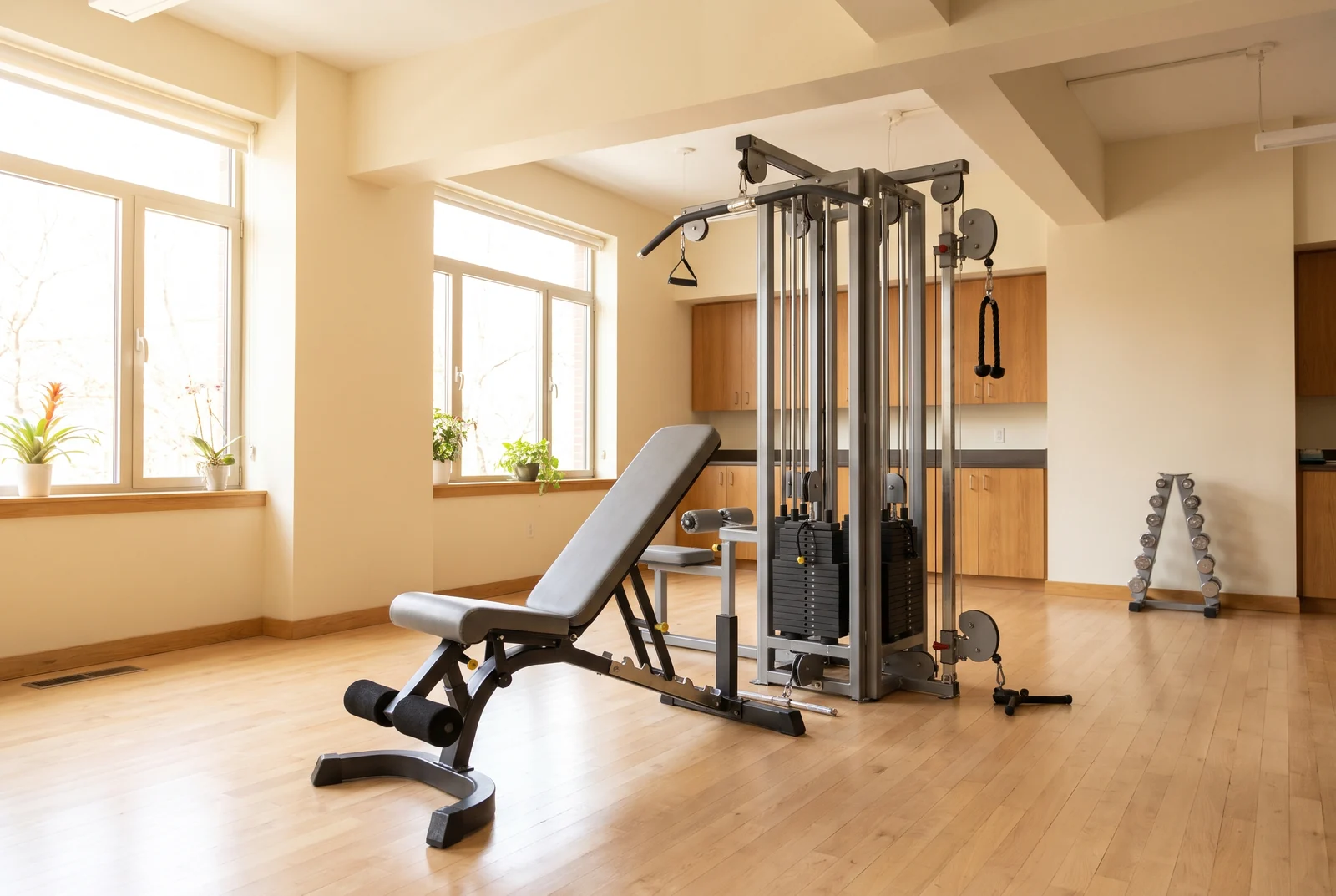
Adults taking tirzepatide lost similar amounts of weight with or without supervised resistance exercise in a new randomized trial. The difference appeared in what they retained and what they could lift: the exercise group lost less lean soft tissue and gained strength, while strength declined in the usual activity group. The 40 week study, published in Nature Medicine on November 9, separates progress on the scale from progress in physical capacity.[1]
Buy 1, Get 1 20% Off
Pick any two research compounds. Take 20% off the lower priced one.
Applied automatically at checkout, no code needed
Claim my 20% off →In every pair, the lower priced item is 20% off after other discounts; accessories excluded. For research use only.
This article reports a clinical study, not a treatment or exercise prescription. IQON Labs reader offers are separate from the research discussed here.
The same weight loss, a different physical outcome
Tirzepatide is an incretin mimetic, a medicine that imitates signals from nutrient stimulated gut hormones. The study examines a consequence of the substantial weight loss these medicines can produce: how to retain physical capacity as body composition changes.[1]
By week 40, estimated average weight loss was 22.28 kilograms in the exercise group and 22.61 kilograms in the usual activity group. Fat mass fell substantially in both groups, with no clear additional fat loss attributable to the exercise program. That similarity makes the differences in lean tissue and strength especially informative.[1][9]
Total lean soft tissue fell by an estimated 3.57 kilograms with exercise and 4.67 kilograms with usual activity. The modeled difference between groups was 1.09 kilograms in favor of exercise, with a 97.5% confidence interval of 0.43 to 1.75 kilograms. The researchers used this interval to account for the study’s two primary outcomes, fat mass and lean soft tissue mass.[1][9]
Exercise therefore reduced the loss rather than preventing it altogether. The result answers a practical research question that a weight reading cannot: can two groups become similarly lighter yet finish with different physical capabilities? The strength measurements supplied the other half of that answer.[1]
Strength improved even as lean tissue declined
In the bench press assessment, estimated average strength rose by 4.68 kilograms in the exercise group and fell by 4.09 kilograms in the usual activity group. The same direction appeared in the lat pulldown and knee extension tests. Participants receiving supervised exercise could lift more at the end even though their measured lean tissue had decreased.[1]
These tests measured performance on particular exercises. They did not measure whether participants had fewer falls, avoided frailty or remained independent for longer. Those are meaningful outcomes for future studies, especially because the people enrolled here were in later middle age and early older age.[1]
The distinction between mass and strength also helps explain why a smaller body composition loss is only part of the finding. Preserving tissue and improving its functional performance are related aims, but neither measurement can stand in for the other.[1]
Why lean tissue is not a muscle count
The study used dual energy X ray absorptiometry, usually called DXA, to estimate body composition. Its lean soft tissue category includes skeletal muscle along with water, organs and other nonfat soft tissues. A loss of one kilogram in this category cannot be read as one kilogram of muscle lost.[1][3]
The authors also point out that adipose tissue contains nonfat components. As fat tissue shrinks, some of those components can disappear from the lean category as well. That complicates any attempt to translate the entire DXA change into muscle loss, particularly during substantial weight reduction.[1]
This makes the paired strength assessments valuable. DXA described changes in tissue compartments; the exercise tests recorded changes in performance. Read together, they support a more specific conclusion than either “all muscle was preserved” or “any lean loss means function worsened.”[1]
Who took part in T-REx
The University of Western Australia team screened 1,251 people and randomized 121. One person withdrew before receiving either intervention, leaving 120 entrants in the analysis: 61 assigned to tirzepatide with usual activity and 59 to tirzepatide with supervised resistance exercise. A total of 111 completed the trial.[1]
The participants were 60 men and 60 postmenopausal women, with an average age of 57.7 years. They had been sedentary and had obesity, or overweight with an associated health condition. The trial excluded people with diabetes or cardiovascular disease, so the results should not be assumed to describe those populations.[1]
T-REx was a phase 3 study at one center. Both groups received tirzepatide; there was no drug placebo group. Its randomized comparison tests the addition of exercise during treatment, rather than the effect of tirzepatide against no medication. The trial was registered as ACTRN12623001236684 in November 2023, before recruitment began.[1][2]
The university’s November 10 announcement emphasized muscle function. The published findings support that emphasis, with an important practical qualification: exercise was personalized and closely supervised at a single study center, and average attendance was 91%. An unsupervised program in everyday life could produce different results.[1][3]
What the safety observations showed
Participants reported adverse events weekly throughout the 40 week intervention. Nausea was reported by 32 of 61 people in the usual activity group and 34 of 59 in the exercise group, or 66 of all 120 participants. Vomiting, constipation, diarrhea and lightheadedness were also reported.[1][8]
Six serious adverse events occurred, five in the usual activity group and one in the exercise group. Investigators assessed them as unrelated to the interventions. Six participants withdrew because of adverse events; two others withdrew after breast cancer diagnoses and one for personal reasons. These findings describe a selected group over 40 weeks and do not establish an absence of risk.[1][8]
How much confidence to place in the result
Participants and exercise staff knew the assignments. The DXA analyst was blinded, but the researchers could not ensure that strength assessors were unaware of group assignments, which matters when interpreting performance tests. The analysis used available repeated measurements and adjusted for age and sex; it was not restricted to the 111 people who completed the study. Its handling of missing observations still depends on statistical assumptions.[1]
The lead investigator disclosed support for the work from a Western Australian State Government Research Excellence Award. Eli Lilly supplied tirzepatide and reviewed the protocol. The company also reviewed the manuscript for intellectual property and new safety information; the paper reports no other company funding or role in conduct. Some authors disclosed speaking or advisory relationships with Lilly and other companies.[1]
The trial gives a concrete reason to evaluate strength alongside weight and body composition in future treatment studies. The next step is to learn how well the gains hold up beyond intensive supervision and whether they translate into everyday mobility and independence.[1]
Sources and further reading
Related reading
Buy 1, Get 1 20% Off
Pick any two research compounds. Take 20% off the lower priced one.
Applied automatically at checkout, no code needed
Claim my 20% off →In every pair, the lower priced item is 20% off after other discounts; accessories excluded. For research use only.