FDA warned Empower Pharmacy on September 18, 2026 about compounding exemption requirements and conditions for sterile production after a November 2025 inspection. Warning letter 738238 questions patient specific prescribing records and the evidence supporting aseptic controls. It requests documented correction; it does not announce a recall or establish contamination in a particular commercial lot.[1]
Buy 1, Get 1 Free
Pick any research compound. The second one is on us.
Applied automatically at checkout, no code needed
Claim my free vial →Lower priced item free; accessories excluded. For research use only.
The IQON catalog placement is separate from this reporting. It does not imply any role in the Empower matter or endorsement by FDA.
Key facts
- The inspection ran from November 3 through November 14, 2025. FDA issued its observation form on the last day.[1]
- The September 18, 2026 letter followed three dated company responses, including one in April 2026.[1]
- The letter separates eligibility for compounding exemptions from concerns about conditions for sterile production.[1]
- Empower told the Houston Chronicle it had already remediated many issues. The letter says some corrections still lacked sufficient support.[1][3]
What happened, and when?
FDA investigators inspected Empower Clinic Services, doing business as Empower Pharmacy, from November 3 through November 14, 2025. The agency issued an inspection observation form at the end of that visit and later reviewed company responses dated December 8, 2025, March 18, 2026, and April 30, 2026. Its September 18, 2026 warning letter addresses both the legal conditions for certain patient specific compounded drugs and conditions for producing products expected to be sterile.[1]
The observations were made during the 2025 inspection, while FDA's written assessment followed months of correspondence. FDA's page records publication on September 22, four days after the letter's date.[1] Coverage that week brought the letter to a wider audience; BioSpace described the manufacturing and copying concerns, while the Houston Chronicle obtained a response from Empower's chief executive.[2][3] The inspection date, letter date and public posting date describe different stages.
The letter names Empower Clinic Services at 7601 N. Sam Houston Parkway West in Houston. It evaluates that facility's records and practices under the conditions described in the document. Readers should not transfer its findings to another facility or assume that every pharmacy compounding pathway has the same exemptions.[1]
Why did the FDA question the compounding exemption?
Section 503A of federal law creates limited exemptions for drugs compounded by qualifying licensed pharmacists or physicians when statutory conditions are met. One condition concerns valid prescriptions for individually identified patients. Another says a compounder must not regularly or in inordinate amounts make products that are essentially copies of commercially available drugs, subject to an exception for a change that the prescriber determines makes a significant difference for an identified patient.[1]
The FDA says its inspectors found some orders without a prescriber's determination of a significant difference. Other orders contained language that appeared repeatedly, raising the possibility that a reason had been preselected rather than written for an individual patient. The agency also cited production and order volume, but the published quantities are redacted. These are the specific records behind its conclusion that certain products appeared to be essentially copies and did not meet the 503A conditions.[1][18]
The distinction is not simply whether an ingredient was added or whether a pharmacy prepared many orders. The Alliance for Pharmacy Compounding, a trade association and therefore an interested participant in the policy debate, cautioned that volume alone is not a numerical violation and that a combination is not automatically a copy. Its stated reading is that the key question is whether a prescriber documented a genuine significant difference for the individual patient. That reading is consistent with the FDA letter's emphasis on missing or repeated determinations, although the agency also explicitly treats volume as evidence in this case.[1][19]
The FDA further says that when the products fail the exemption conditions, they become subject to requirements that otherwise would not apply to those qualifying 503A products, including premarket approval, adequate directions on labeling, and current good manufacturing practice rules. This is the agency's position about the products it calls ineligible, not a blanket conclusion about all pharmacy compounding.[1]
What did inspectors say about sterility?
The second concern stands on its own. The FDA wrote that products intended or expected to be sterile were prepared, packed, or held under insanitary conditions and may have become contaminated or harmful. That is a statement about a risk under manufacturing conditions; it is not a report that laboratory testing found every product contaminated. The letter cites inadequate studies of airflow under working conditions and simulations that did not sufficiently challenge the sterile production process.[1]
In ordinary language, the agency was not satisfied that the production environment and process reliably protected products expected to be sterile. The FDA also listed shortcomings involving maintenance of equipment, procedures to prevent microbial contamination, environmental monitoring, production controls, and quality unit oversight for products it considered ineligible for the 503A exemption. Those findings should be attributed to the regulator, rather than recast as an independently verified assessment of everything made at the facility.[1]
The company had already sent corrective action responses. FDA acknowledged that some measures appeared adequate, but said it could not fully evaluate others because a final airflow study report had not been supplied. It also described discrepancies between a summary of a sterile process simulation and supporting vial records, leaving the claimed absence of contamination in that simulation insufficiently documented to its satisfaction. These are gaps in verification as described by the agency, not evidence that a named lot failed a sterility test.[1]
FDA states that the prohibition on insanitary conditions applies regardless of whether a compounded drug otherwise meets the 503A exemption. A valid reason to customize a product would not by itself resolve concerns about how a product expected to be sterile was made.[1] FDA's general compounding explainer adds that compounded drugs are not FDA approved and are not reviewed for safety, effectiveness, and quality before marketing in the same manner as approved medicines.[4]
What do smoke studies and media fills establish?
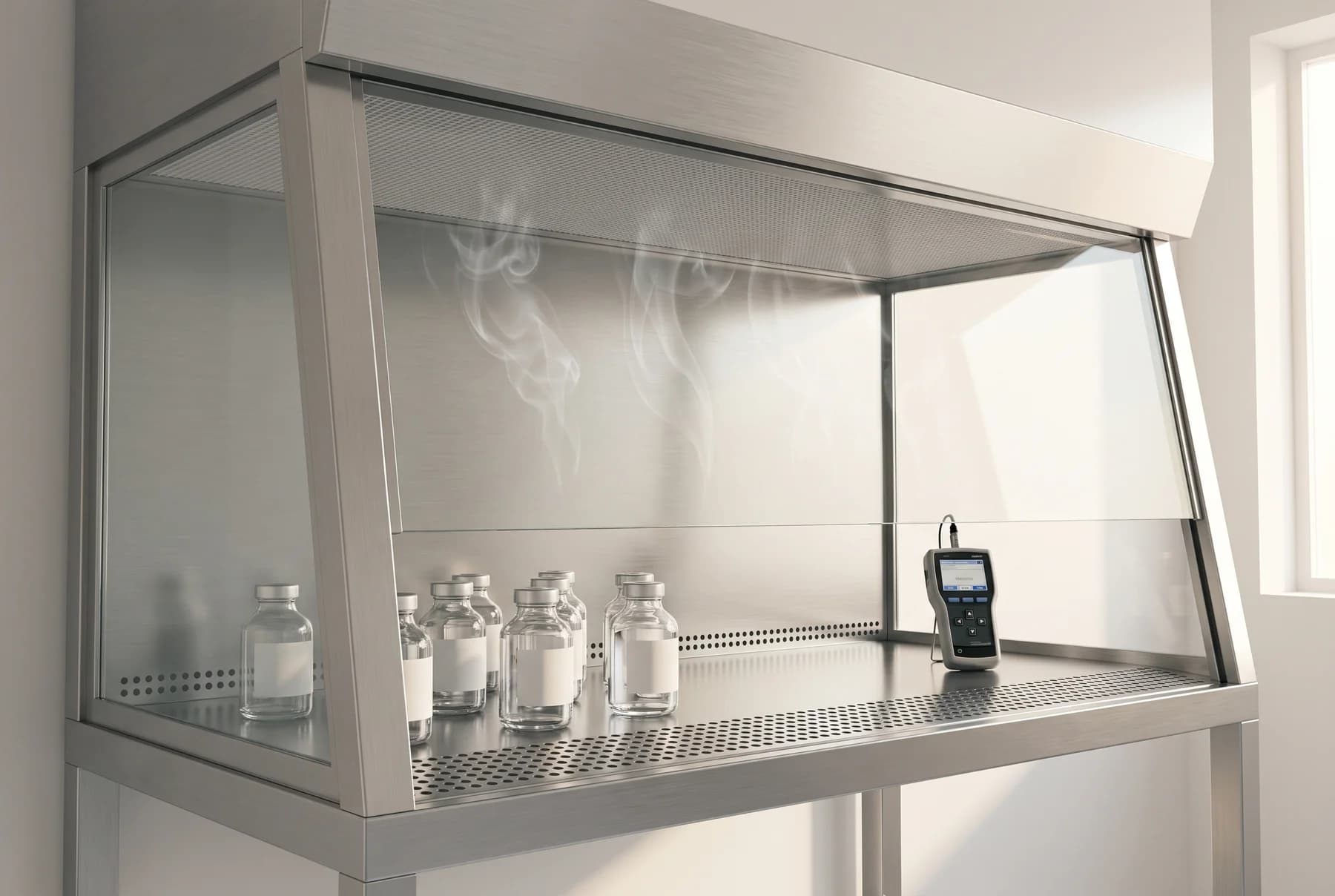
A smoke study makes air movement visible. In this letter, FDA wanted evidence of airflow moving in one direction through the protected work area under dynamic conditions, meaning while work is taking place. A reassuring view of an empty workspace would not answer the agency's question about protection during production. The letter says the studies were inadequate; it does not publish an airflow measurement that readers could use to grade the facility themselves.[1]
A media fill is a simulation used to assess the aseptic process, meaning work intended to prevent microbial contamination. FDA said the company's simulations did not use the most challenging or stressful conditions. That criticism concerns what the exercise tested, rather than simply whether a summary reported a clean result.[1]
The January 2026 simulation illustrates a second problem: the conclusion has to be supported by the records. FDA said the summary claimed all vials had been inspected without contamination, but the supporting counts did not match and some records were unexplained or missing. Some entries marked N/A were not defined. Because several quantities are redacted, the public cannot calculate the size of the gap from this letter.[1]
FDA also questioned results copied onto another form after use of the wrong form. It said that even an administrative correction needs a documented explanation and authorization trail. These details explain why a statement that a simulation passed did not settle the agency's concern. They do not demonstrate that a particular commercial product contained microbes.[1]
What does Empower say?
In a statement reported by the Houston Chronicle, Empower chief executive Shaun Noorian said the company had already remediated many of the issues in the letter and looked forward to working with FDA on the rest. He said the company takes compliance obligations seriously and intends to continue cooperating with the agency. That is the company's stated position, not independent verification that every corrective action has been completed or accepted.[3]
FDA's letter itself acknowledges some responses while saying others lacked sufficient documentation or appeared deficient. Its general policy says a warning letter closeout depends on evaluation and verification of actual corrections, not merely a representation that corrections have been made. The company and regulator may continue corresponding, and the status of corrective actions could change after September 26.[1][20]
What has not been established?
A warning letter is not a recall order. The September 18 document requests a written response within fifteen working days of receipt and says FDA may consider further action if concerns are not adequately addressed. It does not identify a recall number, a set of recalled lots, or instructions to customers to return products. Anyone summarizing this event should avoid saying that the FDA recalled Empower products on the basis of this letter.[1][20]
Nor does the letter establish that contamination occurred in a specific product or that a patient experienced an adverse event. The statutory phrase about products that may have become contaminated describes a hazard. FDA's discussion of incomplete corrective action records is a separate question about whether the agency can verify the company's response. Neither is a finding that all units failed quality testing.[1]
Which documents could change the picture?
A documented FDA update, closeout letter, separate recall record, or company response could change the picture. For this September 26 report, the evidence here supports only the September 18 warning, the company's reported response, and FDA's general explanation of how warning letters are resolved. It does not support predicting an enforcement outcome.[1][3][20]
Frequently asked questions
Did FDA order a recall?
Not in the warning letter reviewed here. It asks Empower to explain corrective steps and leaves room for the firm to dispute FDA's assessment. FDA has a separate process for drug recalls, so a warning should not be described as a recall without a distinct recall record.
Does the letter say every product was contaminated?
No. The agency cites conditions under which products expected to be sterile may become contaminated. That is a serious risk finding, not a product by product laboratory result or a count of affected patients.
Is high production volume itself prohibited?
Not by a simple published numerical cap in the materials reviewed. Section 503A concerns making essentially copied products regularly or in inordinate amounts, and FDA points to volume alongside missing and apparently repeated patient specific determinations. The compounding trade association expressly warns against treating volume alone as the violation.
Does adding a different ingredient automatically make a copy permissible?
No automatic safe harbor appears in the FDA letter. The statutory exception described there turns on a prescribing practitioner's judgment that a change makes a significant difference for an identified individual. FDA questioned records that lacked that determination or appeared to repeat it verbatim.
Has FDA accepted Empower's corrections?
The letter says some responses appeared adequate but others could not be fully evaluated or appeared deficient. The company says it has remediated many issues. FDA explains that a closeout, if issued, follows evaluation of corrective actions, not a promise alone. The September 18 letter does not document acceptance of all corrective actions.
Sources and further reading
- FDA warning letter 738238 to Empower Pharmacy, September 18, 2026
- BioSpace reporting on the September 18 Empower warning letter
- Houston Chronicle: FDA takes issue with Houston based Empower Pharmacy, syndicated by Yahoo
- FDA: Compounding and FDA questions and answers
- CBS News reporting on the Empower Pharmacy warning
- Alliance for Pharmacy Compounding: What a recent FDA warning letter does and does not say
- FDA: About warning and closeout letters
- FDA: Understanding drug recalls
Related reading
Buy 1, Get 1 Free
Pick any research compound. The second one is on us.
Applied automatically at checkout, no code needed
Claim my free vial →Lower priced item free; accessories excluded. For research use only.