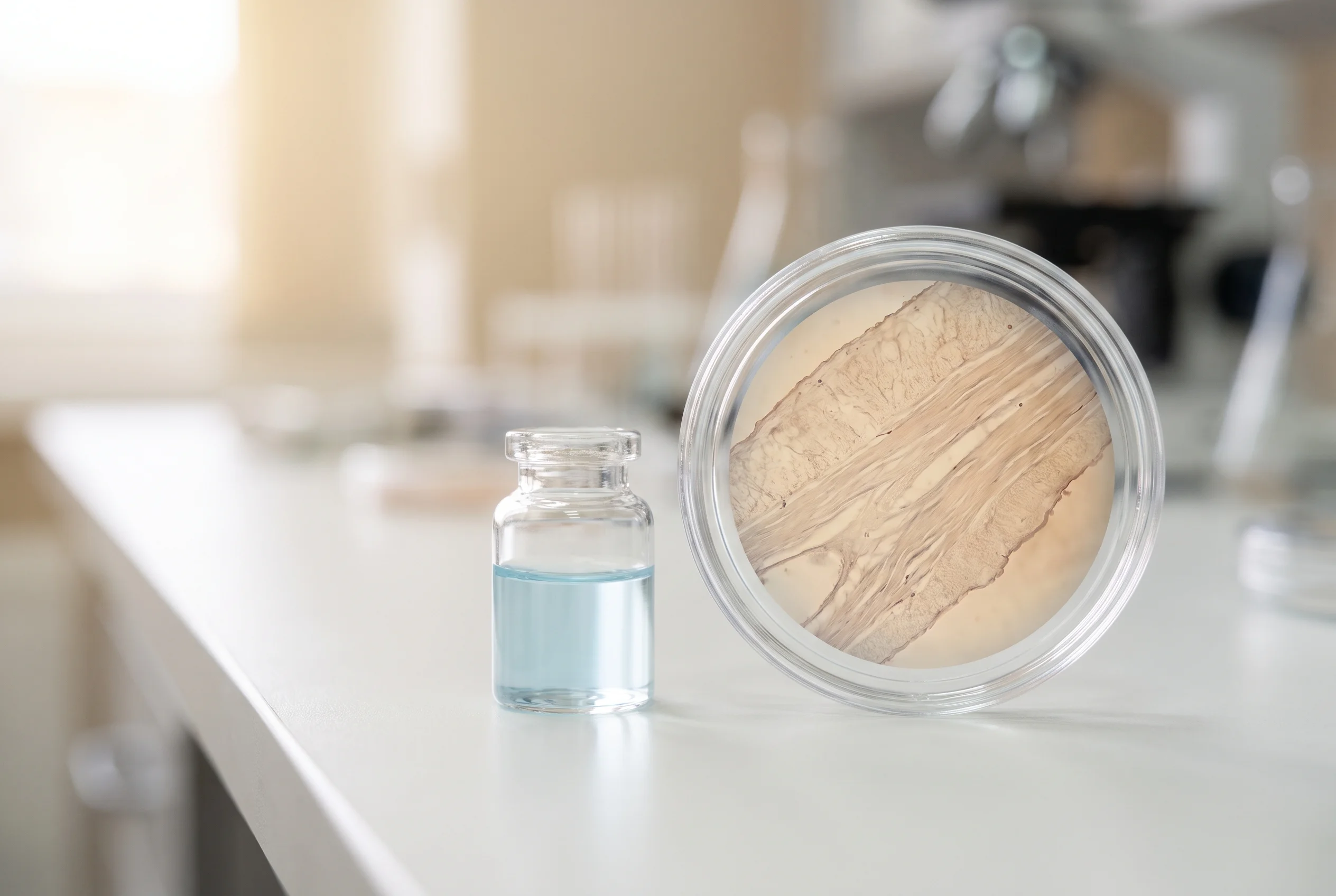
GHK-Cu stimulates collagen production in cultured cells, but its human results depend on what was tested.[1] A diabetic ulcer trial reported greater wound closure, while a small study after laser resurfacing found no statistically significant advantage in measured wrinkles or skin quality.[2][3] The formulation and the measured outcome matter as much as the compound's name.
Buy 1, Get 1 Free
Pick any research compound. The second one is on us.
Applied automatically at checkout, no code needed
Claim my free vial →Lower priced item free; accessories excluded. For research use only.
Correction, October 2, 2026: An earlier version linked an unrelated paper, misstated the ulcer trial's design and results, and reported unverified skin trial figures. It also attributed a combination hair study to GHK-Cu alone and overstated compounding permissions. We have rewritten the article using primary research and FDA documents.
This article explains scientific research, not treatment or administration instructions. Research-grade peptides are for laboratory use only. The studies discussed do not establish clinical uses for products sold as research reagents.
Why a copper peptide attracted collagen researchers
GHK is a short chain of three amino acids, glycyl-L-histidyl-L-lysine, isolated from human plasma. It binds copper, forming the complex called GHK-Cu. In a 1988 experiment, researchers exposed cultured fibroblasts, cells that make connective tissue, to this complex and measured increased collagen synthesis.[1]
The increase occurred without an increase in cell number. That detail matters: the culture was producing more collagen, rather than simply containing more cells. Collagen is a structural protein, so the finding gave researchers a reason to investigate tissue repair. It did not measure how a person's skin looked or how a wound healed.[1]
What the diabetic ulcer trial measured
The 1994 Mulder trial enrolled 181 people with diabetic neuropathic ulcers. It was randomized, conducted at multiple centers and assessed by blinded evaluators. Participants also received structured wound care, including pressure relief and removal of damaged tissue.[2]
The immediate treatment groups received gel or vehicle, its base formulation, for up to eight weeks after removal of damaged tissue, followed by six weeks of observation and wound measurements. A separate delayed treatment comparison began with four weeks of vehicle, then another eight weeks of treatment.[2]
Among participants with plantar ulcers, on the sole of the foot, who began treatment immediately, the gel group had greater median reduction in ulcer area than the vehicle group at the end of the study. This finding concerns that subgroup within the 181-person trial. The endpoint measured changes in wound area, not the percentage of patients whose ulcers had healed completely.[2]
The same immediate treatment plantar subgroup had fewer ulcer infections with gel than with vehicle, although overall adverse-event rates did not differ significantly between the gel and vehicle groups. Several authors were affiliated with ProCyte Corporation, the gel manufacturer. The findings apply to the tested gel within the structured wound-care program; they do not establish the effects of other copper peptide formulations.[2]
Skin results depend on the outcome being measured
A 2006 randomized study examined skin care with or without GHK-Cu after carbon dioxide laser resurfacing around the mouth. Thirteen people completed it. Blinded evaluators and computer analysis assessed redness, and the researchers evaluated wrinkles and skin appearance at 12 weeks.[3]
Both groups improved after the laser procedure. Adding GHK-Cu produced no statistically significant advantage in the objective assessments of redness, wrinkles or overall skin quality.[3]
Participants using GHK-Cu reported greater improvement in overall skin quality on a questionnaire. But they knew which products they received, received them free and had more contact with physicians for product guidance, all potential influences on satisfaction. With only 13 completers recovering from a procedure, the study leaves ordinary skin aging and other formulations unresolved.[3]
Why the hair study cannot isolate a copper peptide effect
A report published in 2025 retrospectively assessed seven men treated between 2018 and 2019 with a combination procedure using copper peptides alongside minoxidil and dutasteride. They also continued topical minoxidil. Dermatologists assessed photographs, with an additional experimental image assessment using ChatGPT. There was no control group and no hair-density measurement by trichoscopy, a magnified scalp examination.[4]
Photographs taken at baseline and one month after completion of the treatment course showed improved scalp coverage. The report described no observed scarring or infection in these participants over that observation period. Because several treatments were combined, it cannot identify how much, if any, of the change came from copper peptides. The paper describes copper peptides in the mixture; it is not a trial of GHK-Cu alone.[4]
The authors reported no study funding. Carlos Wambier disclosed advisory roles with Chemistry Rx, Daniel Alain and Young Pharmaceuticals, along with investigator roles for several drug companies. These disclosed relationships belong alongside the study's small sample and uncontrolled design when weighing its findings.[4]
How the evidence fits together
- The fibroblast experiment measured collagen production in a cell culture.[1]
- The ulcer trial measured healing within a structured care program using a particular topical gel.[2]
- The resurfacing trial separated measured skin changes from participants' satisfaction.[3]
- The hair report assessed a combination procedure without a control group.[4]
GHK-Cu and the FDA: route and category matter
FDA's May 14, 2026 category list includes GHK-Cu for routes other than injection in Category 1. Its explanatory note records an April removal after nominations were withdrawn, followed by a May clarification that restored the nomination for non-injectable routes.[5]
Category 1 is an interim evaluation category. FDA describes conditional enforcement discretion for substances on it, meaning the agency does not intend to take certain enforcement action when the policy's conditions are met. It is not drug approval or an unrestricted permission to compound.[6]
For injectable GHK-Cu, FDA still identifies potential immune reactions associated with peptide clumping or impurities and limited human safety data.[7] Its planned advisory review is explained in our guide to the second FDA peptide meeting.
What would make the clinical answer stronger?
The useful next result would identify a specific formulation, compare it with an appropriate control and measure a clinically meaningful change over a stated period. It would also report adverse events and whether any benefit persisted. Those details would make it possible to judge a new study against the wound, skin and hair findings already described.
Copper peptide collagen research gives a biological reason to investigate GHK-Cu. A claim about healing, appearance or hair growth still needs support from an experiment measuring that outcome. Better controlled studies could clarify which formulations have useful effects, for whom and with what risks.
Frequently asked questions
What is a vehicle control?
A vehicle is the base formulation used to carry the ingredient being tested. Comparing a treatment with that base helps researchers distinguish an ingredient's effect from the effects of the formulation and accompanying care.
What does immunogenicity mean?
Immunogenicity is the capacity to trigger an immune response. FDA raises this concern for injectable GHK-Cu because peptide clumping and impurities may affect that response. It is a safety question about the preparation, not a measure of its intended effect.
Sources and further reading
- Maquart et al. (1988). Collagen synthesis in fibroblast cultures.
- Mulder et al. (1994). Enhanced healing of ulcers in patients with diabetes.
- Miller et al. (2006). Effects of topical copper tripeptide complex on CO2 laser-resurfaced skin.
- Kuceki et al. (2025). Combination treatment study for androgenetic alopecia.
- FDA. Bulk drug substances nominated under section 503A. Updated May 14, 2026.
- FDA. Bulk drug substances used in compounding under section 503A.
- FDA. Safety risks associated with certain bulk drug substances.
Related reading
Buy 1, Get 1 Free
Pick any research compound. The second one is on us.
Applied automatically at checkout, no code needed
Claim my free vial →Lower priced item free; accessories excluded. For research use only.