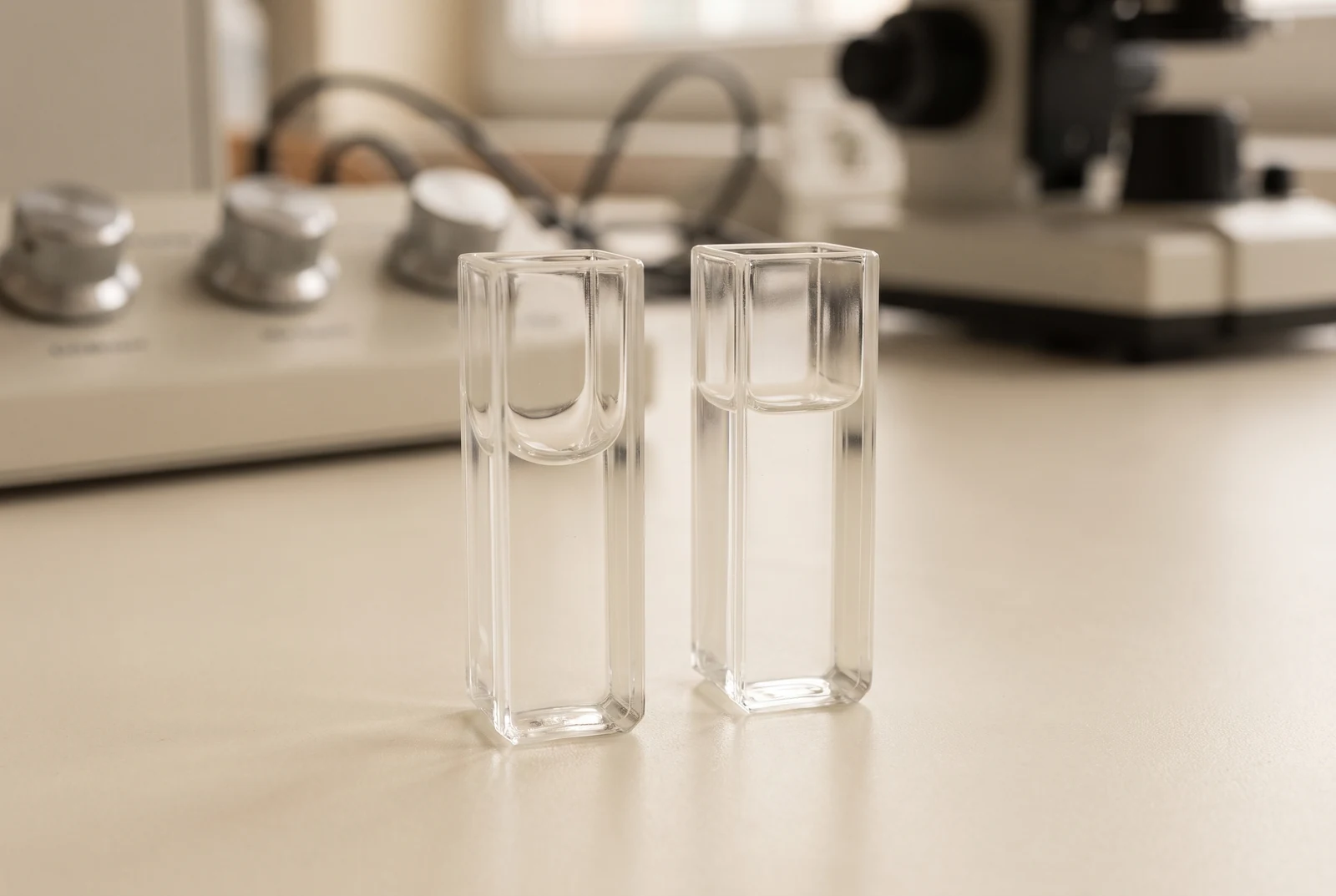
A scrambled peptide keeps the same amino acids in a different order. That makes it a useful comparison for sequence dependence, but does not guarantee inactivity. Published experiments show scrambled controls forming fibrils or changing a gel's physical environment, even when the biological behavior differs from the original peptide.[1][2]
Buy 1, Get 1 20% Off
Pick any two research compounds. Take 20% off the lower priced one.
Applied automatically at checkout, no code needed
Claim my 20% off →In every pair, the lower priced item is 20% off after other discounts; accessories excluded. For research use only.
IQON Labs' research use only catalog is separate from these experiments. The studies do not evaluate the catalog.
The comparison preserves ingredients, not behavior
The attraction is straightforward: if a peptide produces an effect and a rearranged version does not, the difference supports a role for sequence order. A control with the same composition helps test whether simply adding those amino acids in peptide form is enough. The difficulty is that rearrangement also changes which residues sit next to one another and how molecules interact.[1][2]
A useful negative control therefore has two jobs. It must lack the activity being tested, and it must remain sufficiently comparable in other properties for the difference to be interpretable. Studies of amyloid peptides and cell culture gels show how those jobs can come apart.[1][2]
A scrambled amyloid peptide still formed fibrils
In a 2017 FEBS Letters paper, Vadukul and colleagues tested reversed and scrambled versions of amyloid beta 42, a peptide widely studied in Alzheimer's disease research. Both types were being used as controls on the assumption that they would lack the native peptide's tendency to assemble and harm cells.[1]
Electron microscopy and circular dichroism showed that the control peptides could form fibrillar structures with substantial beta sheet character, an ordered arrangement of neighboring peptide strands. In these preparations, both controls assembled rapidly. The scrambled sequence also escaped the aggregation prediction made by the WALTZ algorithm, showing why a reassuring prediction could not replace a physical measurement.[1]
Yet the cellular result was different from the assembly result. In cultured primary rat hippocampal neurons, the reversed and scrambled preparations caused less cell death than the native peptide preparation enriched in oligomers, the smaller assemblies associated with its toxicity in this experiment. The controls' ability to form fibrils did not make their cellular effects identical to those of the original.[1]
This is a narrower and more useful conclusion than declaring the controls either valid or invalid for everything. A scrambled preparation can help compare a particular cell response while failing as a control for the absence of assembly. The authors also stressed that suppliers can use different scrambled sequences. Evidence about one rearrangement cannot establish the behavior of another.[1]
Changing a binding motif also changed the gel
A 2025 study in Chemistry: A European Journal made the physical mismatch especially visible. Al Taief and colleagues compared Fmoc GFFRGD with Fmoc GFFRDG. The peptides carried the same amino acids and the same Fmoc chemical cap, but the final two residues switched places. The RGD motif is recognized by integrins, cell surface proteins involved in adhesion; RDG served as the scrambled comparison.[2]
That small rearrangement changed how the peptides assembled. The two materials needed different concentrations to form gels and produced different fiber networks and mechanical properties. The authors connected these changes to altered intermolecular interactions, including the positions of charged groups.[2]
Cells cultured on those gels were consequently experiencing more than a change in the order of the adhesion motif. The investigators compared the pure gels at their respective minimum gelation concentrations, which differed. Experiments with fibroblasts, including primary fibroblasts associated with a mouse pancreatic tumor model, found differences in cellular behavior and markers of activation across the matrices.[2]
The authors explicitly cautioned that they could not quantify integrin binding specificity from this comparison because the changed structure and stiffness complicated the interpretation. Cell viability or adhesion in the scrambled gel did not prove that RDG reproduced RGD's receptor interaction. Nor could every difference be assigned to loss of that interaction.[2]
This is where a nominally matched control can introduce a confound. Keeping the amino acid inventory fixed did not keep the culture environment fixed. For a claim about receptor recognition, the gel's physical differences need to be considered alongside its sequence.[2]
When inactivity is measured in the assay
A 2014 PLOS ONE study offers a contrasting example. Smadbeck and colleagues designed a peptide called SQ037 to inhibit EZH2, an enzyme involved in adding methyl marks to histone proteins. They compared it with a scrambled sequence in nuclei isolated from HeLa S3 cells, using mass spectrometry to follow newly added histone methylation.[3][4]
The scrambled control did not inhibit the formation of new H3K27 trimethylation, a mark consisting of three methyl groups on lysine 27 of histone H3, in that assay, while SQ037 reduced it. The investigators also examined other histone methylation sites to assess the specificity of the inhibitor's effect. Here, inactivity was an experimental observation tied to a particular readout.[3]
Because the experiment used isolated nuclei, it did not establish that either peptide could enter an intact cell. Its value for the control question is more precise: the scrambled comparison helped test the methylation response in a system where access through the outer cell membrane had been removed from the problem.[3]
Define what the control is meant to rule out
The starting question should be the proposed explanation for the result. A claim about a recognition motif needs a comparison that examines recognition. A claim about assembly needs evidence of what each peptide actually forms. A cell response measured in a scaffold also depends on the physical scaffold the cells experience.[1][2][3]
That often means pairing the biological readout with another measurement. Microscopy or spectroscopy can check assembly, while a functional assay can test whether the intended activity was lost. The limitations of aggregation measurements matter here because a dim signal alone cannot certify an unassembled control.[1][2]
The useful statement is specific: this sequence, in this preparation and assay, lacked the measured effect. The amyloid controls and the gel comparison show what is lost when that finding is shortened to a universal label of inactivity. Scrambling creates a candidate control; the experiment establishes what it controls for.[1][2][3]
Sources and further reading
- Amyloidogenicity and toxicity of the reverse and scrambled variants of amyloid‐β 1‐42. DOI: 10.1002/1873-3468.12590
- Scrambled RGD Hexameric Peptide Hydrogel Supports Efficient Self‐Assembly and Cell Activity. DOI: 10.1002/chem.202404410
- De Novo Peptide Design and Experimental Validation of Histone Methyltransferase Inhibitors. DOI: 10.1371/journal.pone.0090095
- Correction: De Novo Peptide Design and Experimental Validation of Histone Methyltransferase Inhibitors. DOI: 10.1371/journal.pone.0095535
Related reading
Buy 1, Get 1 20% Off
Pick any two research compounds. Take 20% off the lower priced one.
Applied automatically at checkout, no code needed
Claim my 20% off →In every pair, the lower priced item is 20% off after other discounts; accessories excluded. For research use only.